
10 Screen-Free After-School Activities That Need Almost No Preparation
· Craftiverse Editorial Team
Ten easy after-school activities using paper and everyday supplies, with clear instructions, quieter alternatives, and a realistic routine for tired families.
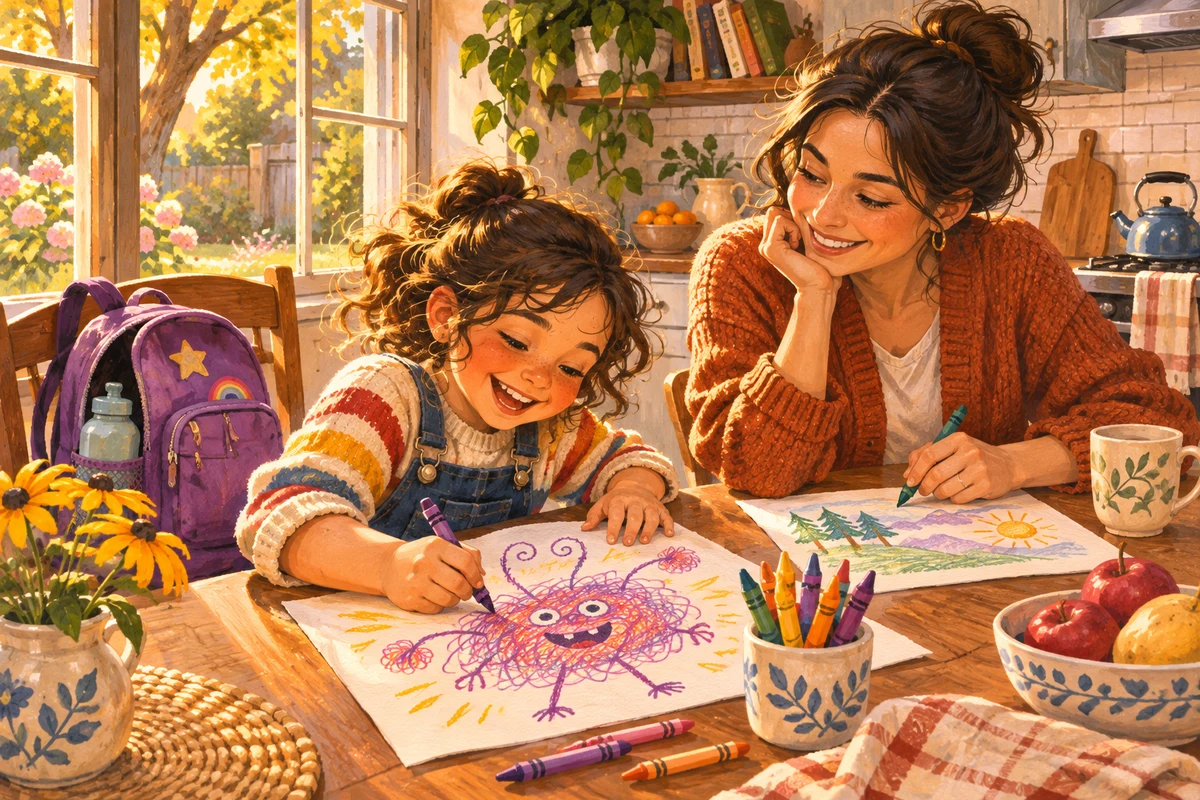
Illustration created for Craftiverse; the scene is illustrative.
Before choosing an activity
An after-school activity does not need to fill the whole afternoon. Your child may want company, movement, quiet, or no organized activity at all. Ask “Would you like to move around or sit beside me?” rather than presenting a long list. You can try an idea later if now is the wrong time.
These setup and play times are planning estimates, not targets or developmental expectations. Use supplies suited to your child’s skills, and supervise cutting and small pieces. Clear a safe floor space before movement games.
Choose by energy and available supplies
| Today feels like… | Try this | Set out |
|---|---|---|
| Quiet and tired | Scribble creatures or a tiny book | Paper and crayons |
| Ready to move | Animal moves or a shape hunt | A clear space |
| Wanting company | Pass-the-picture or a puppet story | Paper; optional clean paper bag |
| Wanting to build | A paper bridge or box town | Paper; clean cardboard |
1. Turn a scribble into a creature
Draw a looping line on paper. Let your child rotate the page and decide what they can see, then add eyes, feet, or a setting with a crayon. Invite a story: “Where does it live?” For a child who dislikes drawing, you can make the marks while they direct you. Allow roughly five minutes.
2. Make a tiny folded book
Fold a sheet in half, then in half again. Use the outside as a cover and the inside spaces for pictures; there is no need to cut or staple it. Make a story about the journey home. A younger child can dictate while you write; an older child can add speech bubbles.
3. Play pass-the-picture
Each person draws on their own sheet, then swaps when both are ready. Add something to the new picture and swap again. Agree first that pictures may change in surprising ways. If sharing artwork feels upsetting, draw side by side instead.
4. Build a paper bridge
Place two sturdy books a short distance apart on a table and lay a sheet between them. Fold another sheet into a zigzag and test whether it spans the same gap. Use a paper figure as a passenger, not heavy objects. Ask “What could we change?” and try one alteration together.
5. Tell a puppet story
Draw a face on a clean paper bag, or draw a character on a folded sheet. Give the character a small problem: it has lost its hat, or needs a home. Let your child choose what happens next. No completed costume, stage, or script is necessary.
6. Go on an indoor shape hunt
Find something round, something rectangular, and something with a triangle in its design. Point rather than collect fragile or heavy objects. Extend it by drawing a map of the finds. Keep cupboards, plugs, windows, and climbing out of the game.
7. Make a tear-and-arrange collage
Tear scrap paper into pieces and arrange them into a garden, robot, or abstract pattern. Skip glue so the pieces can move again. If you want to save it, let your child choose which pieces to stick. Use large pieces where small scraps are unsuitable.
8. Try animal moves
Choose three animals and move like each one across a clear space: slow bear steps, gentle bird wings, or stretching like a cat. Walking, seated arm movements, and pointing to animal pictures are equally valid versions. Avoid furniture jumping or races on slippery floors.
9. Build a box town
Use a clean small box as a house, shop, or garage. Draw doors and windows on it instead of cutting them out. Add paper roads on the table. An older child can label places, while a younger sibling moves a large pretend character through town.
10. Create a family postcard
Fold or trim paper into a card, then draw one thing you want to tell someone about. The message can be dictated, written, or shown with a picture. Keep it for a family member or deliver it in person; you do not need to photograph or post your child’s work online.
A repeatable routine for tomorrow
Settle first; offer two choices; put out one tray; join in briefly if invited; then decide what to keep. Before stopping, say “One more thing, then we’ll save this.” A tray or folder lets unfinished work wait without taking over the table.
If every idea gets a “no,” stop offering more. Try “I’ll be here drawing if you want to join.” These are invitations, not a test of whether you are providing a good enough afternoon.
Common questions
How long should an after-school activity last?
There is no required length. Start with a small invitation and follow your child’s interest. Stop or pause when they are tired or no longer enjoying it.
What if I do not have time to prepare anything?
Put paper and a crayon on the table and offer scribble creatures. Or choose a shape hunt, which needs no craft supplies.
Can these replace all screen time?
They are options for part of the day, not a complete family media plan. Choose routines that fit your household.
Sources & editorial notes
The resources below inform the general approach. The activity instructions, sample words, and planning tables are original Craftiverse suggestions; they have not been clinically evaluated.
- American Academy of Pediatrics: Indoor Play Ideas
Background on making, pretending, and playing together. Craftiverse created the practical routines below.
Written by the Craftiverse Editorial Team · Published 21 November 2026. This article has not been reviewed by a clinician. Read our about page or contact us about a correction.