
What to Say When Your Child Says “I Can’t Draw”
· Craftiverse Editorial Team
Practical responses to drawing frustration, with gentle prompts, three easy drawing games, and ways to help without taking over your child’s artwork.
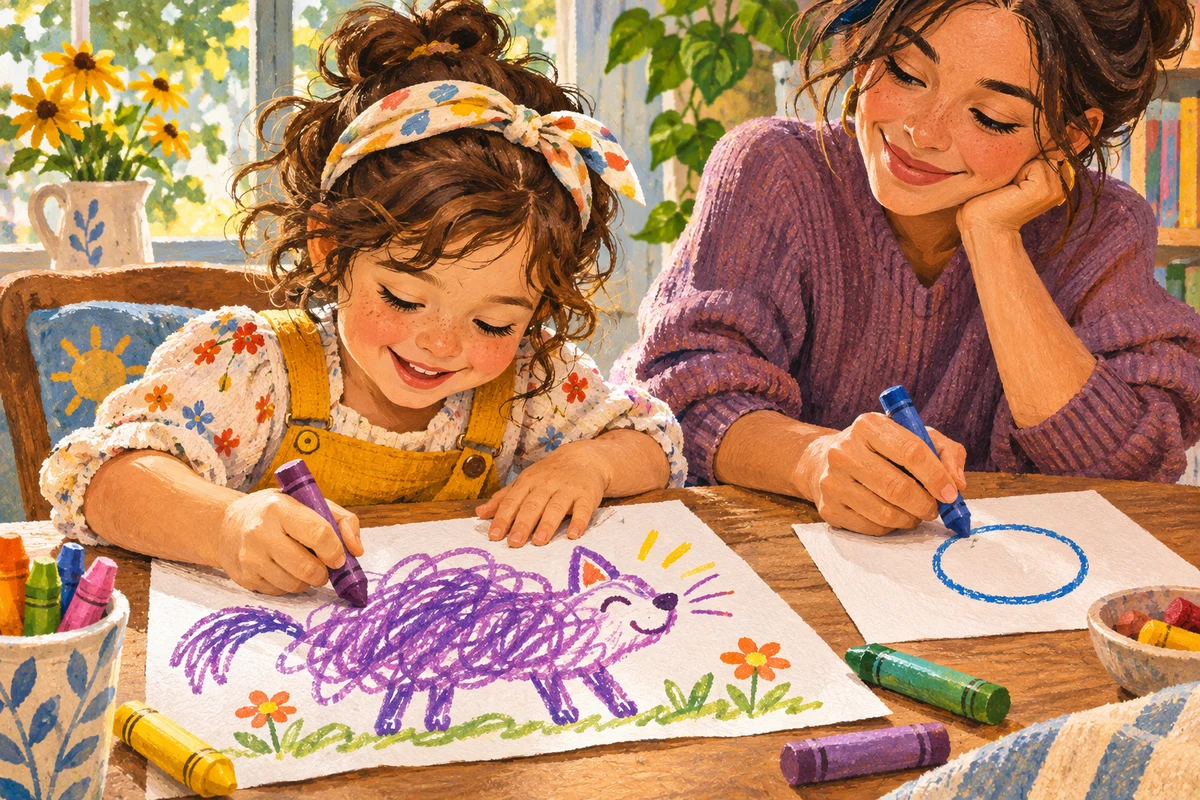
Illustration created for Craftiverse; the scene is illustrative.
Listen for what “I can’t” means
A child may mean “I can’t make it look like the picture,” “I don’t know where to start,” or simply “I’m tired.” Begin with a question that does not feel like a quiz: “Which bit feels tricky?” If talking adds pressure, sit nearby or offer a pause.
A frustrating drawing session is not a diagnosis or a measure of creativity. Children can enjoy making things through arranging, building, pretending, and choosing colors as well as drawing.
Words you can use in the moment
| What your child says | A possible response | A small next step |
|---|---|---|
| “It looks wrong.” | “You had a different picture in mind.” | Ask which one part they want to change. |
| “Draw it for me.” | “Want me to try on my own paper?” | Model a shape separately, then hand back the choice. |
| “Yours is better.” | “We made different versions.” | Put away the example if comparison is getting in the way. |
| “I’m done.” | “Okay. Save it, use the back, or recycle it?” | Accept their decision. |
Help with one part instead of finishing the picture
Ask permission before touching their page. If they want help drawing a cat, you might draw a circle on a separate scrap, then ask what shapes they want for ears. Your version is one possibility, not the correct answer. Keep your demonstration short so the child has space to experiment.
You can hold a sliding page, open a marker, or help position materials without deciding what goes on the paper. If gripping tools is uncomfortable, try a different size of crayon, a larger sheet, or arranging torn paper instead.
Game 1: the three-shape creature
Set out paper and crayons. Each person chooses three shapes: perhaps a circle, a long rectangle, and a triangle. Use those shapes in any order to invent a creature. Add a name and decide how it travels. It is finished whenever its maker says so.
Make it easier by drawing the shapes yourself on separate paper and inviting your child to add one feature. Make it more involved by inventing a home or a second creature. The aim is experimenting with shapes, not accurate animal drawing.
Game 2: turn the page
Draw one curved line, then turn the paper a quarter turn. Ask “Does it remind you of anything?” Add a mark, rotate again, or leave it as a pattern. A child can direct the drawing with words or gestures while you make the marks.
Avoid asking “What is it?” after every mark. Some pictures are just enjoyable lines and colors. “You filled this corner with spirals” gives you something to talk about without requiring a recognizable object.
Game 3: a picture with two jobs
Draw an everyday object, such as a cup, then imagine it doing an unexpected job: a home for a tiny dragon, a spaceship, or a mountain. Add one detail that shows the new job. If drawing the cup is the sticking point, start with a large U-shape or a pre-drawn outline.
Keep the first round small. One invented detail is enough; a whole page of background scenery can wait.
Respond to the process without turning it into another task
Notice a specific choice when it feels natural: “You tried a wide line for the road” or “You moved that piece before you glued it.” Ask what your child likes about the picture, and accept “nothing yet” as an answer. You do not need a positive comment for every action.
Avoid forcing a lesson about perseverance during a meltdown. Put the supplies somewhere safe and reconnect later. If they return, ask whether they want a fresh page or the same one.
If drawing keeps becoming upsetting
Offer a different creative route for a while: paper collage, building from clean boxes, or making up puppet stories. Do not use artwork to compare siblings or judge readiness for school.
If you notice ongoing pain, difficulties using tools across everyday tasks, or distress that concerns you beyond this activity, speak with a qualified professional who knows your child. This article offers play ideas, not an assessment.
Common questions
Should I stop showing my child examples?
Examples can help when a child wants instructions. Offer them as possible starting points and put them away if matching the example is causing frustration.
Is tracing okay?
Tracing can be one enjoyable option if your child chooses it. Keep other options available, including free marks, collage, and drawing from imagination.
Should I make my child finish?
A pause or unfinished picture is allowed. You can offer to save it, but the activity does not need a finished product to have been worthwhile.
Sources & editorial notes
The resources below inform the general approach. The activity instructions, sample words, and planning tables are original Craftiverse suggestions; they have not been clinically evaluated.
- NAEYC: Supporting the Development of Creativity
Background on open-ended art and exploring materials. The activity plans and example conversations here are Craftiverse suggestions.
- CDC: Tips for Child-led Play
Guidance for toddler and preschool play, including following a child’s lead and describing their actions. Older-child examples here are our adaptations.
Written by the Craftiverse Editorial Team · Published 21 November 2026. This article has not been reviewed by a clinician. Read our about page or contact us about a correction.
Choose a free craft to try together