
10 Quiet Activities for Kids While You Cook Dinner
· Craftiverse Editorial Team
Ten low-preparation activities for a safe space away from cooking hazards, with supervision notes, setup instructions, and a printable dinner-time menu.
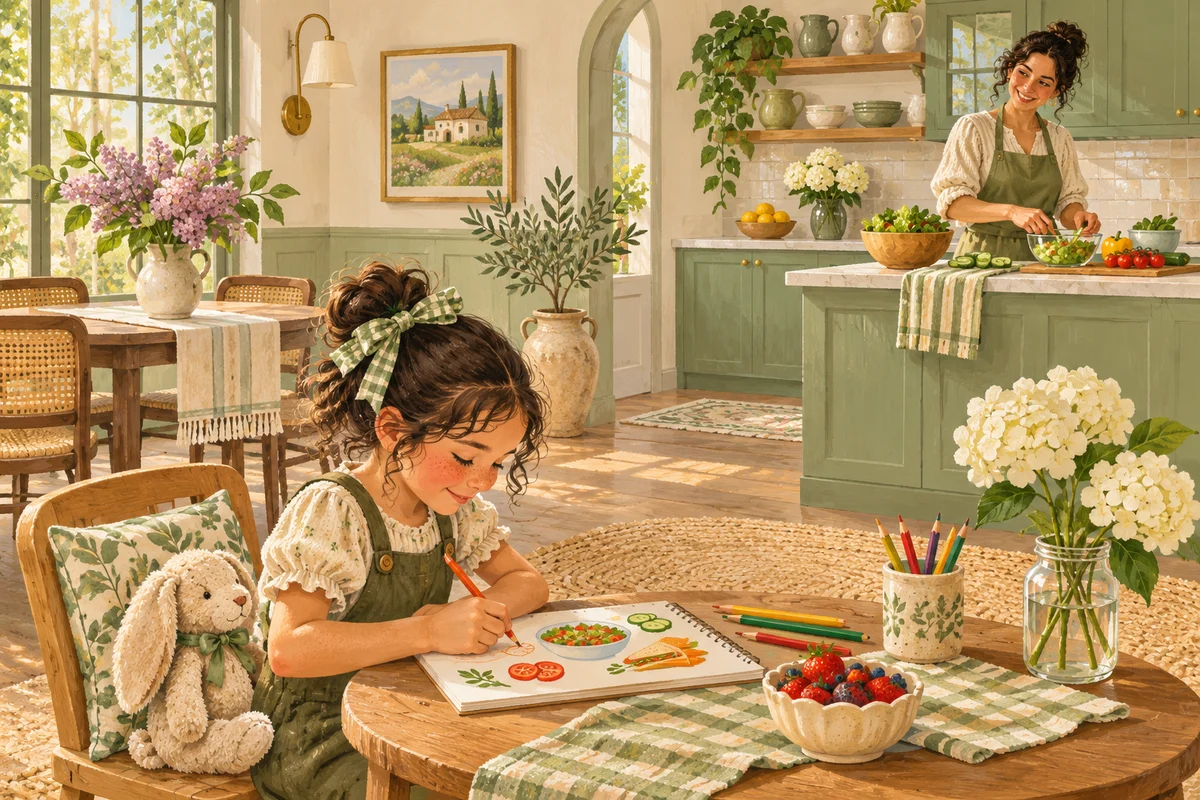
Illustration created for Craftiverse; the scene is illustrative.
Safety and supervision come before the activity
These are ideas for children who can use the selected materials with the supervision you can provide. They are not instructions to leave a young child alone while cooking. For babies and toddlers, follow age-appropriate safety guidance and your child’s needs rather than using a craft list as a supervision plan.
Choose a place away from the stove, oven, kettle, hot dishes, knives, appliance cords, and routes used to carry food. Being able to see a child is not always enough: if the task needs hands-on help, stop what you are doing before helping. Set boundaries and gather the supplies before heat or sharp tools are in use.
1. Draw a pretend café menu
Put paper and a few suitable crayons at the table. Invite your child to draw three dishes for an imaginary café. They can invent names or dictate them later; this is pretend play, not a request to handle the ingredients you are using.
2. Design a placemat
Draw a large plate circle on paper before cooking begins. Your child can add a border, patterns, or a picture around it. Keep the drawing separate from food and remove it before serving if it could interfere with the meal.
3. Look through a familiar picture book
Offer two books your child can handle comfortably. Ask them to choose a favorite page to show you once the cooking task is safely paused. The invitation does not need a reading quiz or a written response.
4. Invent an imaginary restaurant
Use a sheet of paper as a sign and let your child choose the restaurant’s name, special dish, and a mascot. A nonwriter can draw the ideas. Leave scissors and glue out of this version so the setup stays simple.
5. Try a paper pattern path
Draw two winding lines with space between them. Invite your child to fill the path with dots, dashes, or repeating colors. Use wider paths or a larger crayon if small marks are frustrating. There is no required neatness.
6. Make a toy picnic
Set out a few large, suitable toys in an agreed place away from the cooking area. Your child can arrange a pretend picnic using imaginary food. Avoid small accessories, real food, or utensils that could be confused with cooking tools.
7. Draw a family portrait
Ask your child who belongs in the picture; people, pets, and imaginary friends can all be included. Offer a few crayons rather than a large open art box. They can show you the story behind the picture when it is safe to give your attention.
8. Find details in a picture
Use a familiar picture book and invite your child to find three animals, round things, or objects of one color. They can point or remember a favorite. This stays at the table; it is not a scavenger hunt through kitchen cupboards.
9. Fold a paper fan
For a child already comfortable folding, show alternating folds before you begin cooking. Then let them decorate the closed fan with marks. If they need repeated hand-over-hand support, choose a different task for cooking time.
10. Plan tomorrow’s story
Invite a drawing of a character, a place, and something the character needs. Your child can tell you the story after dinner. If they prefer speaking, they can quietly tell it to a toy while they wait; no drawing is necessary.
When the activity ends before dinner is ready
Plan for short interest rather than promising thirty uninterrupted minutes. Offer one familiar alternative, or pause the meal preparation and reconnect. If your child repeatedly needs help, use the safest suitable arrangement for them and simplify dinner.
Store the dinner-time supplies separately from food-preparation tools. Put away crayons and paper before serving; help with handwashing as appropriate. A calm transition matters more than finishing the drawing.
Common questions
Are these suitable for toddlers?
Not automatically. Choose materials and a safe arrangement suited to the individual child. Young children may need supervision incompatible with cooking at the same time.
Which choices need the least setup?
A familiar book, paper with suitable crayons, or a few large familiar toys. Check the space and supplies first.
Can I use scissors or small craft decorations?
Avoid tools or small parts that need supervision you cannot provide while cooking. Prepare a simpler dry activity instead.
Sources & editorial notes
The resources below inform the general approach. The activity instructions, sample words, and planning tables are original Craftiverse suggestions; they have not been clinically evaluated.
- American Academy of Pediatrics: Kitchen Safety
Background on keeping children away from cooking hazards. A quiet activity does not replace supervision.
Written by the Craftiverse Editorial Team · Published 21 November 2026. This article has not been reviewed by a clinician. Read our about page or contact us about a correction.
Set up a portable activity tray