
“I’m Bored!”: 15 Easy Activities Kids Can Choose Themselves
· Craftiverse Editorial Team
A practical activity menu for bored kids: 15 simple choices, supplies and setup notes, plus a free printable choice board parents can adapt.
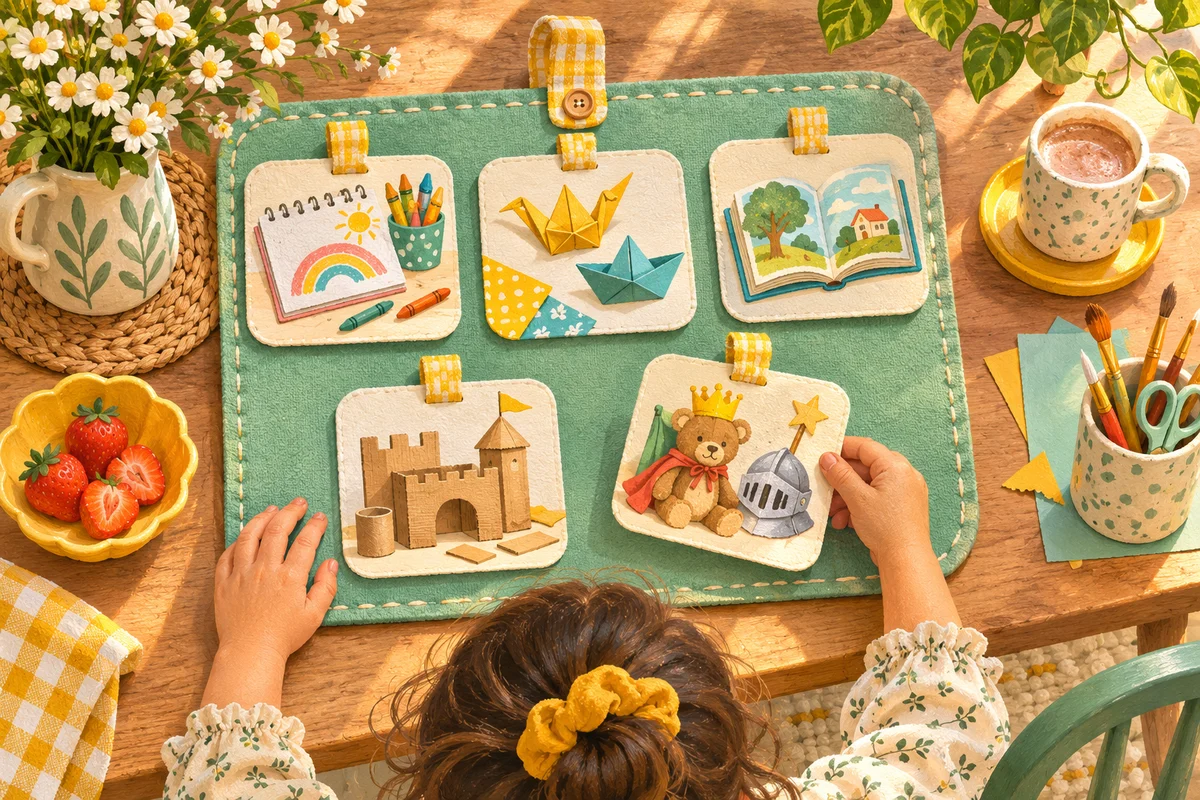
Illustration created for Craftiverse; the scene is illustrative.
Make choosing easier before adding more ideas
When your child says “I’m bored,” first consider whether they want connection, a rest, or something to do. Try “Would you like company, a quiet choice, or a moving choice?” An activity menu is useful when they want ideas; it is not a requirement to keep them occupied every minute.
Before offering the board, cross out choices that need supplies you lack or supervision you cannot provide. The words “choose yourself” refer to deciding what to try, not to a promise that every child can complete it alone. Let a younger child point to a picture or ask you to read two options.
15 ideas, with enough detail to start
| Choice | How to begin | Set out / check |
|---|---|---|
| 1. Scribble creature | Draw a loose scribble; add a face or legs. | Paper and crayons |
| 2. Tiny book | Fold paper twice; draw one event in each space. | Paper; no staples needed |
| 3. Paper town | Stand folded paper tents up as buildings. | Paper on a stable table |
| 4. Shape detective | Find three round things by pointing. | No climbing or opening cupboards |
| 5. Color hunt | Find something matching each crayon. | Stay in an agreed safe area |
| 6. Toy picnic | Arrange a pretend meal for large toys. | Suitable toys; no real food needed |
| 7. Make a menu | Draw three dishes for an imaginary café. | Paper and crayons |
| 8. Design a flag | Choose a symbol and two colors. | Paper; display flat |
| 9. Build a bridge | Span two low books with folded paper. | Paper and sturdy books |
| 10. Tell a puppet story | Give a drawn character a tiny problem. | Paper or clean paper bag |
| 11. Draw a map | Map an imaginary island or your room. | Paper and crayons |
| 12. Pattern path | Draw repeating marks along a paper path. | Paper and crayons |
| 13. Silly animal moves | Choose three animals and move gently. | Clear space; seated version is fine |
| 14. Picture postcard | Draw something you want to tell someone. | Paper; adult can write dictated words |
| 15. Revisit a project | Choose one saved creation to change. | Safe unfinished project and its supplies |
Use the printable board without turning it into homework
Print the board, then circle three choices that fit today. Your child can point, mark a box, or tell you their choice. If reading is difficult, sketch a tiny picture beside the option or read the shortlist aloud. You do not need to cut the cards apart.
Leave a blank space for an idea your child invents. A menu works best as a starting point, not a list to finish. Do not make a child earn a preferred activity by completing all the others.
If your child rejects every option
Try one small invitation rather than another longer list: “I’m making a map at the table; you can join me.” They may prefer to watch at first. If they are tired or upset, put the board away and return later. Refusing a craft is not a behavior problem by itself.
When a child wants your company, five minutes together at the start may be more useful than finding a supposedly perfect independent activity. Choose a moment you can realistically share and say what will happen when you need to stop.
Adjust the choices to the child
Prepare large paper pieces for someone who finds cutting difficult. A child who dislikes drawing can direct a story while you make marks, or build with folded paper instead. Movement choices can use arms or seated gestures rather than hopping. Adapt around comfort and ability, not just an age printed on a list.
Check the play area and materials before you step back. Keep small scraps away from younger siblings and store adult tools separately. The board can stay the same while the available choices change with the supervision you have.
Keep what works and replace what does not
After a few tries, ask which two activities deserve a place on tomorrow’s menu. Add a new invitation only when it helps; novelty is not the goal. Store a small supply set together so a chosen activity is easy to start and tidy.
If making a board becomes another task for you, skip it. Two spoken choices count. The useful part is giving your child a manageable decision and a clear beginning.
Common questions
How many choices should I offer?
Start with two or three suitable options. You can show more when your child wants a wider menu.
Can young children use this alone?
An adult should choose safe materials, read or explain options when needed, and provide supervision appropriate to the child.
What if they choose the same activity every day?
Repetition is allowed. Offer a small variation if they want one, rather than requiring a new activity.
Sources & editorial notes
The resources below inform the general approach. The activity instructions, sample words, and planning tables are original Craftiverse suggestions; they have not been clinically evaluated.
- CDC: Tips for Child-led Play
Background on following a young child’s lead. The activity menus and older-child adaptations are Craftiverse suggestions.
Written by the Craftiverse Editorial Team · Published 21 November 2026. This article has not been reviewed by a clinician. Read our about page or contact us about a correction.
Choose a free illustrated craft