
One Craft, Different Ages: Making Together With Siblings
· Craftiverse Editorial Team
Adapt one paper-bag puppet project for different ages and abilities, with shared supplies, separate choices, and a plan for turns and tricky moments.
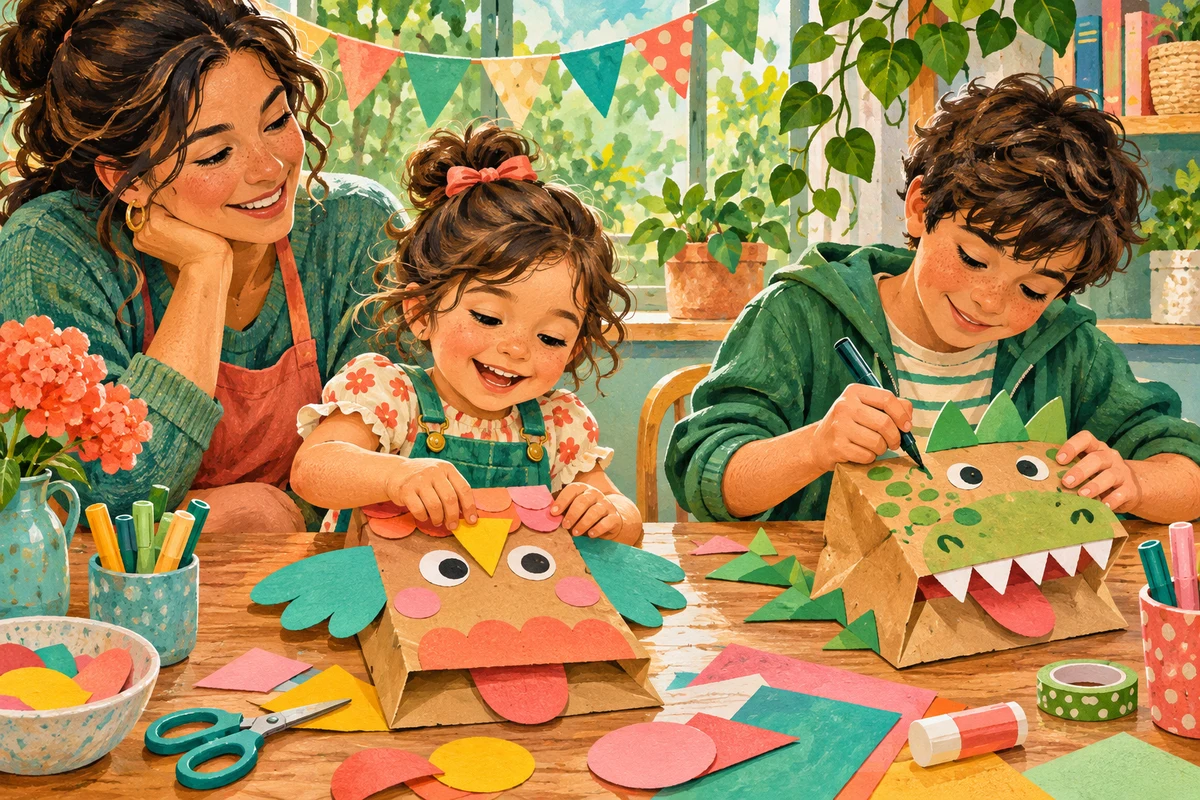
Illustration created for Craftiverse; the scene is illustrative.
Plan around abilities, not a strict age label
Two children of the same age may want very different support. Use the options below as invitations rather than milestones. Consider interest, tool confidence, attention, sensory preferences, and whether a child wants you nearby.
Choose a moment when you can supervise the tools in use. If the younger child needs your full attention, simplify the older child’s task or save cutting for another time. An older sibling should not have to supervise the younger one.
Set up one paper-bag puppet project
For each child, prepare a clean paper lunch bag, paper for features, and a marker or crayon. Add a glue stick and suitable scissors where appropriate. Draw eyes on paper instead of using loose small parts when those are unsuitable. A grown-up can prepare shapes in advance.
Lay the bag flat with its bottom flap facing you. That flap can become the moving mouth. Try the hand movement before gluing so decorations do not seal it shut. A folded-paper character is an alternative if bags are unavailable.
Three ways to join in
| Participation option | The child’s job | Grown-up support |
|---|---|---|
| Arrange prepared pieces | Choose colors; place large eyes, a belly, or spots. | Prepare shapes and help apply glue if needed. |
| Build from a short guide | Draw or cut simple features; test the moving mouth. | Demonstrate tricky steps on a spare piece. |
| Invent a new version | Design a character, movable detail, or story setting. | Help check tools and test how pieces attach. |
Make the puppets together
- Let each child choose a character. Keep the theme broad: animals, imaginary creatures, or people are all possibilities.
- Place facial features before gluing. Open and close the bag flap to check the mouth still moves.
- Attach large features, then decorate. Offer help with only the part a child wants help with; keep adult-made examples on separate paper.
- Let glue set as directed on its label. Try a short puppet conversation when the pieces are secure.
- Ask each maker what they want to do next: play, add details, save it, or stop. There is no shared finishing deadline.
Give each child ownership
Use separate bags and paper piles even if tools are shared. Ask before touching another person’s work. If one child wants to copy the other’s color choice, remind both that similar ideas can still become different creations.
Invite cooperation after individual choices are established: “Would your puppets like to visit the same place?” A joint stage can be optional. Do not require siblings to combine projects if one wants to keep theirs separate.
Handle tools and turns before an argument starts
Say how sharing will work: “You use the scissors for these two shapes, then we swap.” Offer the waiting child a real task, such as drawing a face, rather than asking them to sit idle. You can do the cutting yourself if sharing a tool makes supervision difficult.
If a disagreement escalates, separate materials and pause. Avoid comparing speed or skill. “You are working on different parts” is more useful than naming one child the better artist.
When one child finishes first
Offer an independent extension: draw a ticket for a puppet show, make a background on paper, or invent a character name. They can also leave the table. Finishing first does not make them the helper unless they freely choose that role.
Keep a safe stopping point for the other child. “We can save the spikes for tomorrow” respects their pace without holding the whole family at the table.
Make participation more flexible
If sticky textures are unwelcome, let a child direct placement while you handle glue. If cutting is tiring, offer prepared pieces. A child who does not want to speak can move the puppet while someone else narrates, or simply arrange the characters in a scene.
Afterward, ask one easy question: “Would you do this again, or change something?” Use the answer to plan the next shared project. Success can be a short, enjoyable time together rather than matching finished puppets.
Common questions
What age gap works for a shared craft?
There is no fixed age gap. Choose materials safe for the youngest participant and offer different jobs and levels of support. Some sessions will work better separately.
Should the older child help the younger one?
They may choose to help, but should not be responsible for safety, supervision, or finishing the other child’s project.
What if one sibling dislikes the project?
Offer a related role, such as making a scene, or a separate activity nearby. Joining the same craft should be optional.
Sources & editorial notes
The resources below inform the general approach. The activity instructions, sample words, and planning tables are original Craftiverse suggestions; they have not been clinically evaluated.
- American Academy of Pediatrics: Indoor Play Ideas
Background on making, pretending, and playing together. Craftiverse created the practical routines below.
Written by the Craftiverse Editorial Team · Published 21 November 2026. This article has not been reviewed by a clinician. Read our about page or contact us about a correction.
Open the free dinosaur puppet guide