
A Week of Screen-Free Family Fun: 7 Activities, One Supply Basket
· Craftiverse Editorial Team
Seven flexible family activities using one modest supply basket, with instructions, a combined checklist, quick alternatives, and a free printable weekly planner.
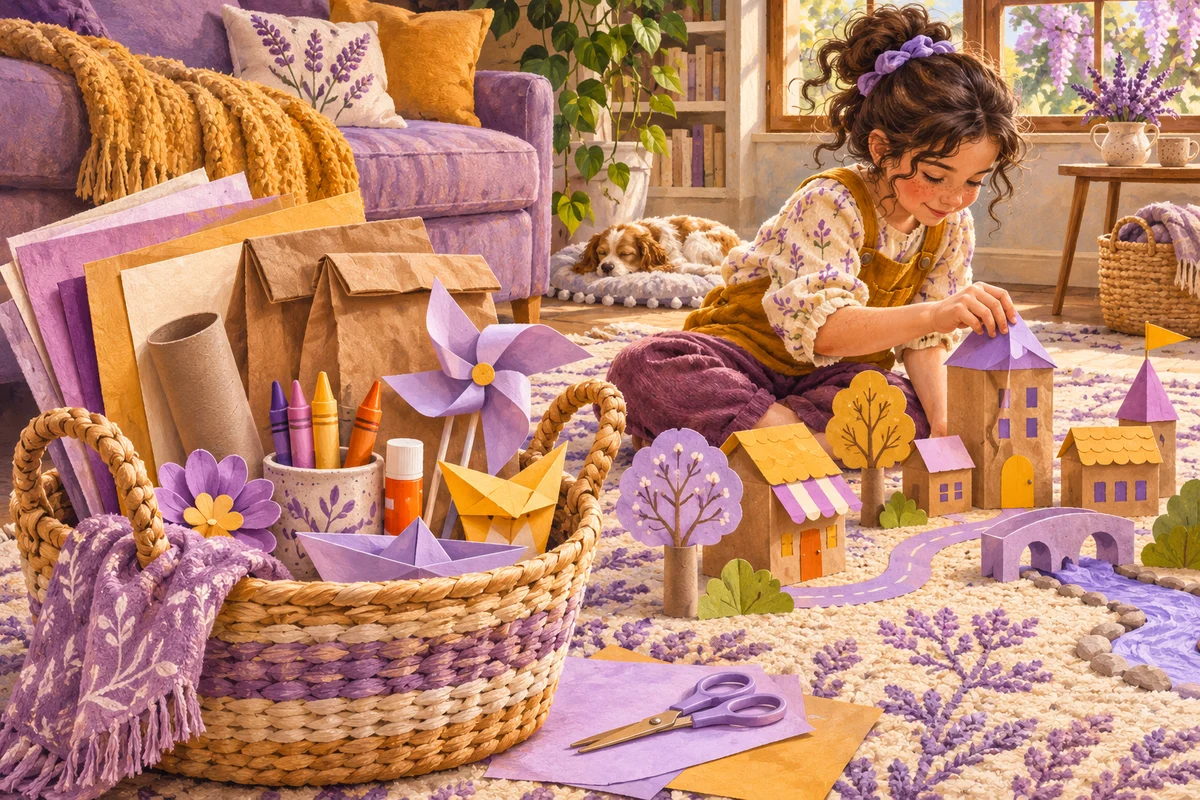
Illustration created for Craftiverse; the scene is illustrative.
Prepare one small basket, not seven kits
This plan is a set of invitations, not a challenge to finish. Most sessions can begin with roughly five to fifteen minutes, but those are planning estimates rather than promises. Allow more time for glue to set and for children who want to keep making. You can spread the week across a month.
Set aside the supplies below before starting. Keep scissors and other tools stored safely between sessions, especially if younger children can reach the basket. You do not need to buy decorations, print templates, or collect a large amount of recycling.
Combined materials checklist
- About twelve sheets of plain or colored paper, plus useful scraps; reuse blank backs where appropriate.
- A few crayons or washable markers suited to your child.
- Two clean paper lunch bags, or extra paper for flat characters.
- Two clean small cardboard boxes; remove staples, packaging film, and sharp edges.
- One glue stick, suitable scissors for supervised use, and a pencil.
- Two sturdy books for a low paper-bridge test, used under adult guidance.
- A shallow tray or mat, a cloth, and a folder or small box for saved work.
Day 1: invent a scribble creature
Each person draws one loose line, rotates the paper, and adds a creature around it. Give it a name if you want. Save the drawing for a later story. Quick version: choose a color and draw one face.
Invite a child who dislikes drawing to direct the marks or arrange torn paper instead. Leave enough paper in the basket for tomorrow rather than putting everything on the table at once.
Day 2: build a small paper town
Fold two sheets into standing tents as buildings. Use a clean box as a larger building and draw doors rather than cutting openings. Add a paper road and choose a place the creature from day one might visit. Quick version: draw one house on a flat sheet.
Day 3: make a paper-bag character
Draw features on a clean paper bag or prepare large paper eyes, ears, and a belly. Test how the bottom flap moves before attaching pieces so the mouth stays free. Quick version: draw a face on folded paper and tell one line of dialogue.
Day 4: test a paper bridge
Put two sturdy books a short distance apart on the table. Span the gap with a sheet, then test an accordion-folded sheet. Use a small paper character as a passenger rather than heavy objects. Quick version: fold a paper ramp and slide a paper scrap along it.
Ask what your child wants to change instead of insisting on a winning design. If the test becomes frustrating, save it for another day.
Day 5: open a pretend café
Draw a menu with three imaginary dishes. Fold a paper sign and let a toy or paper character place an order. Keep real food out of this craft version. Quick version: invent one outrageous dish and draw it.
Day 6: tell a tiny adventure
Choose a character from earlier in the week and a place in the paper town. Give it a small problem, such as finding the café or crossing the bridge. Take turns adding one event, or let one person narrate while another moves the character. Quick version: choose where the character goes next.
Day 7: make a small gallery and reset
Choose a few creations to display temporarily. Let each maker decide whether to give theirs a title or describe it. Nobody needs to rank the work. Quick version: each person chooses one thing they enjoyed making.
Ask what should be saved and what can be reused. Put flat pieces in the folder, protect standing pieces in a small box, and clear the rest. Use the answer to “What would we do again?” to plan next week.
Use the weekly planner flexibly
Print the sheet and write your own day beside each invitation. Move sessions around, cross one out, or repeat a favorite. Put an adult-help note beside any tool or step that needs it. A skipped day does not create catch-up work.
For siblings, keep separate paper piles and let them choose different jobs. For a child who wants more detail, extend the scene; for someone tired, keep the quick version. The point is a usable family routine, not seven matching finished projects.
Common questions
Do we need to stop using screens for the whole week?
No. These are screen-free activity sessions within your ordinary routine, not a complete family media plan.
Can we use fewer supplies?
Yes. Replace paper bags with folded-paper characters and cardboard buildings with drawn ones. Keep the invitation and simplify the construction.
What if we miss a day?
Skip it, move it, or repeat another activity. The planner is a tool, not a streak or a required schedule.
Sources & editorial notes
The resources below inform the general approach. The activity instructions, sample words, and planning tables are original Craftiverse suggestions; they have not been clinically evaluated.
- CDC: Tips for Child-led Play
Background on following a young child’s lead. The activity menus and older-child adaptations are Craftiverse suggestions.
Written by the Craftiverse Editorial Team · Published 21 November 2026. This article has not been reviewed by a clinician. Read our about page or contact us about a correction.
Find more practical Parent Corner ideas