
5 Paper Games Kids Can Make and Play Together
· Craftiverse Editorial Team
Make matching pairs, mini dominoes, tic-tac-toe, a race game and draw-and-guess cards. Includes complete rules and free print-friendly game sheets.
A craft that becomes a game gives you two activities: making the pieces and using them together. These five games use paper or thin card, drawing tools and simple shapes. A grown-up can prepare the cut pieces; the child can draw pictures, color the board and choose the theme.
Read the rules before decorating. A game becomes harder to play if the matching cards have different backs, the dominoes do not have clear values, or the race track has no obvious order. The finished images are examples; use the numbered play sheet and rules below for the exact game layout.
These are small homemade games rather than tested commercial game sets. Play a short practice round, explain a confusing rule, and adjust the difficulty together. No timer is needed.
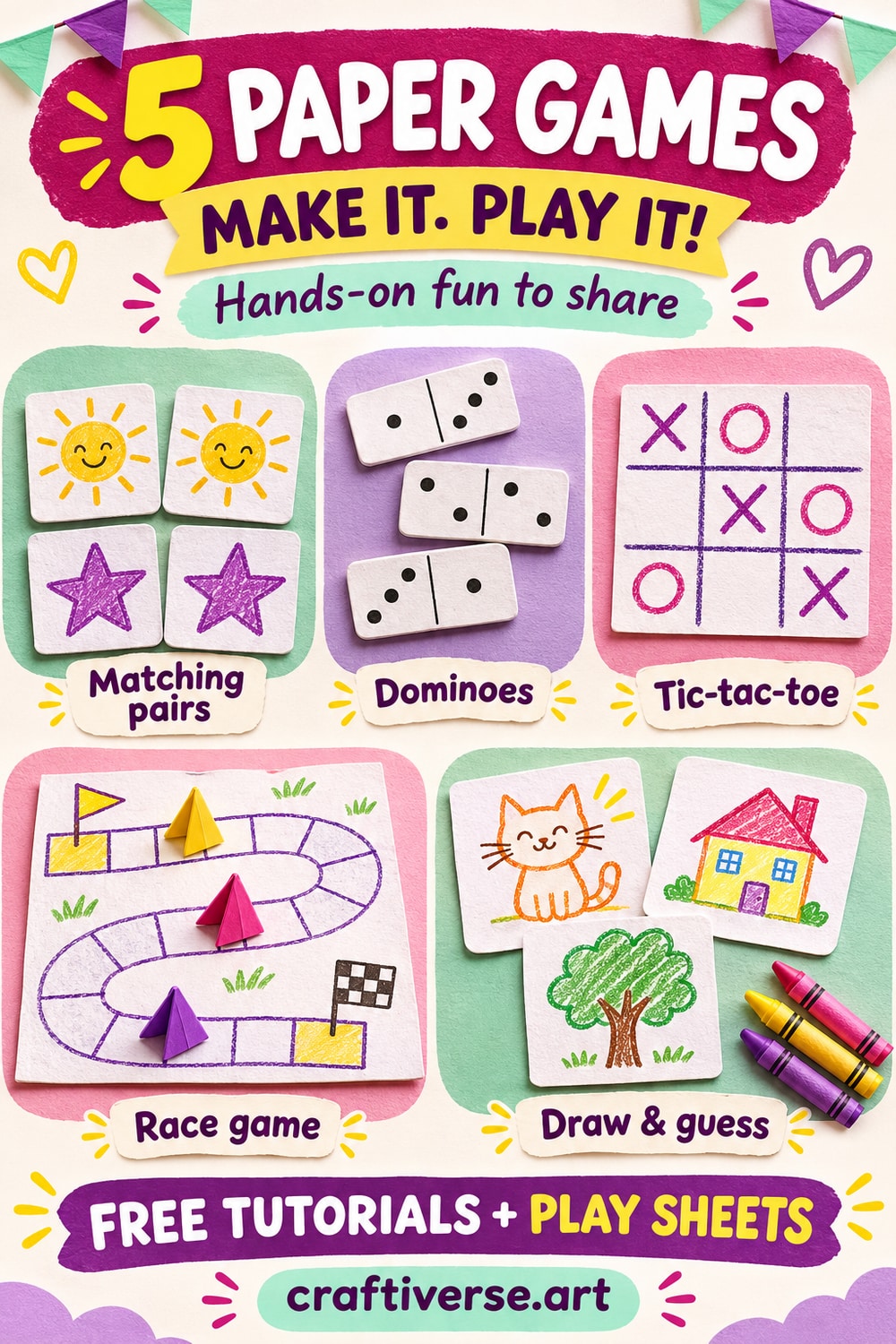
Finished-project illustrations show possible results. Change the colors and details to make your own version.
What you’ll need
- Paper or thin cardstock
- Pencil, markers or crayons
- Child-safe scissors with grown-up help where needed
- Optional ruler for grids
- Two larger folded-paper markers for the race
Keep pieces large enough to handle comfortably. Draw on one side of matching cards only. A printer is optional: all boards and pieces can be drawn by hand.
1. Matching pairs cards
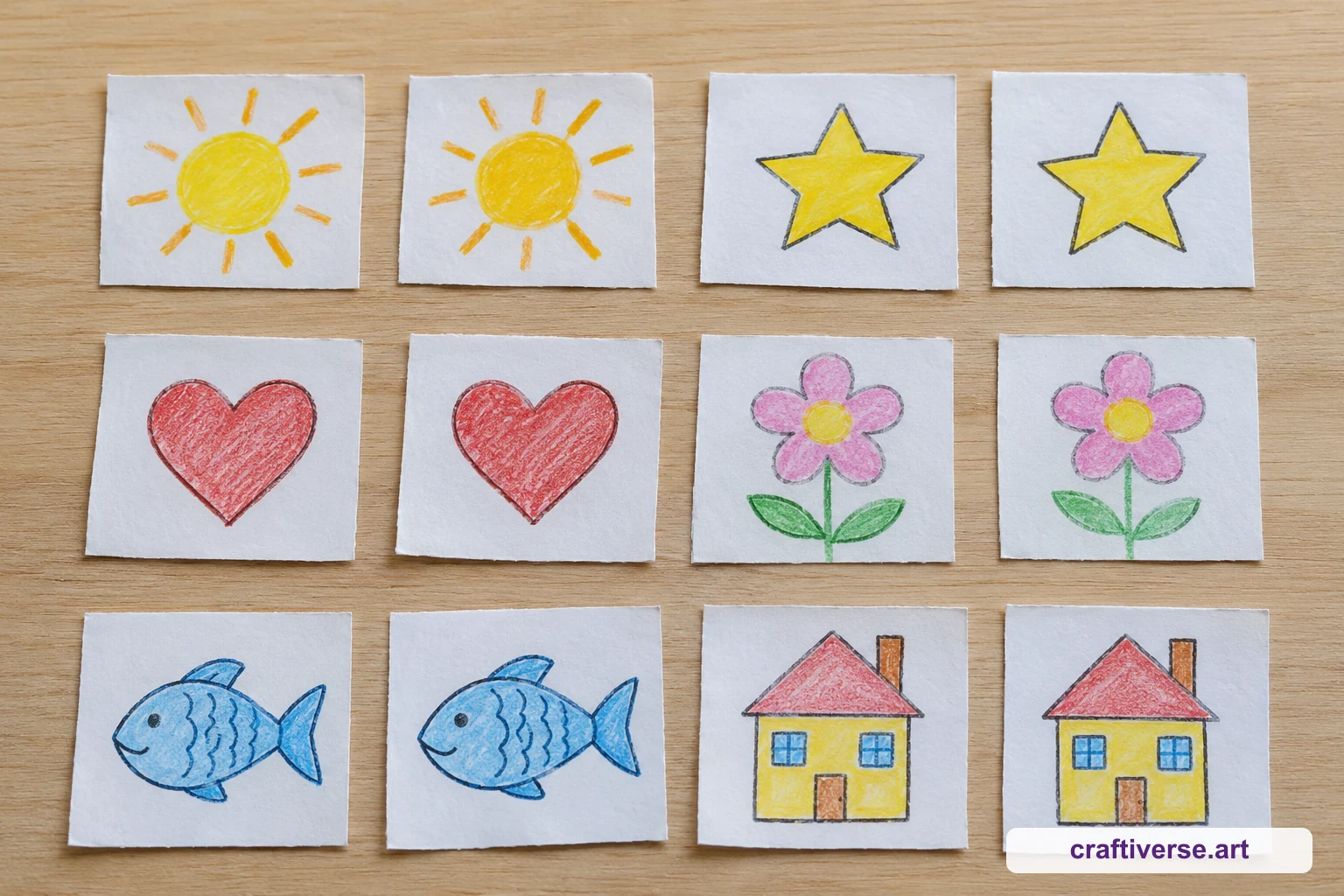
Make six matching pairs for a twelve-card game. Use fewer pairs for a shorter first round.
Materials
- Twelve same-sized paper or card rectangles
- Drawing tools
- Scissors or prepared cards
How to make it
- Prepare twelve rectangles with identical plain backs. Cut the pieces first with grown-up help.
- Choose six simple pictures, such as a sun, star, heart, flower, fish and house.
- Draw each picture on exactly two cards. Keep both cards in a pair easy to recognize.
- Color the fronts if you want, leaving every back plain so it does not reveal the picture.
- Check that there are twelve cards and six pairs, then turn them all face down and mix them.
How to play
- Arrange the cards face down in three rows of four.
- On a turn, reveal two cards so everyone can see them.
- If they match, keep the pair and take another turn. If they do not, turn both face down again and pass the turn.
- Continue until all six pairs have been found. Each pair is one point; most points wins, and a tie is a shared win.
2. Mini paper dominoes
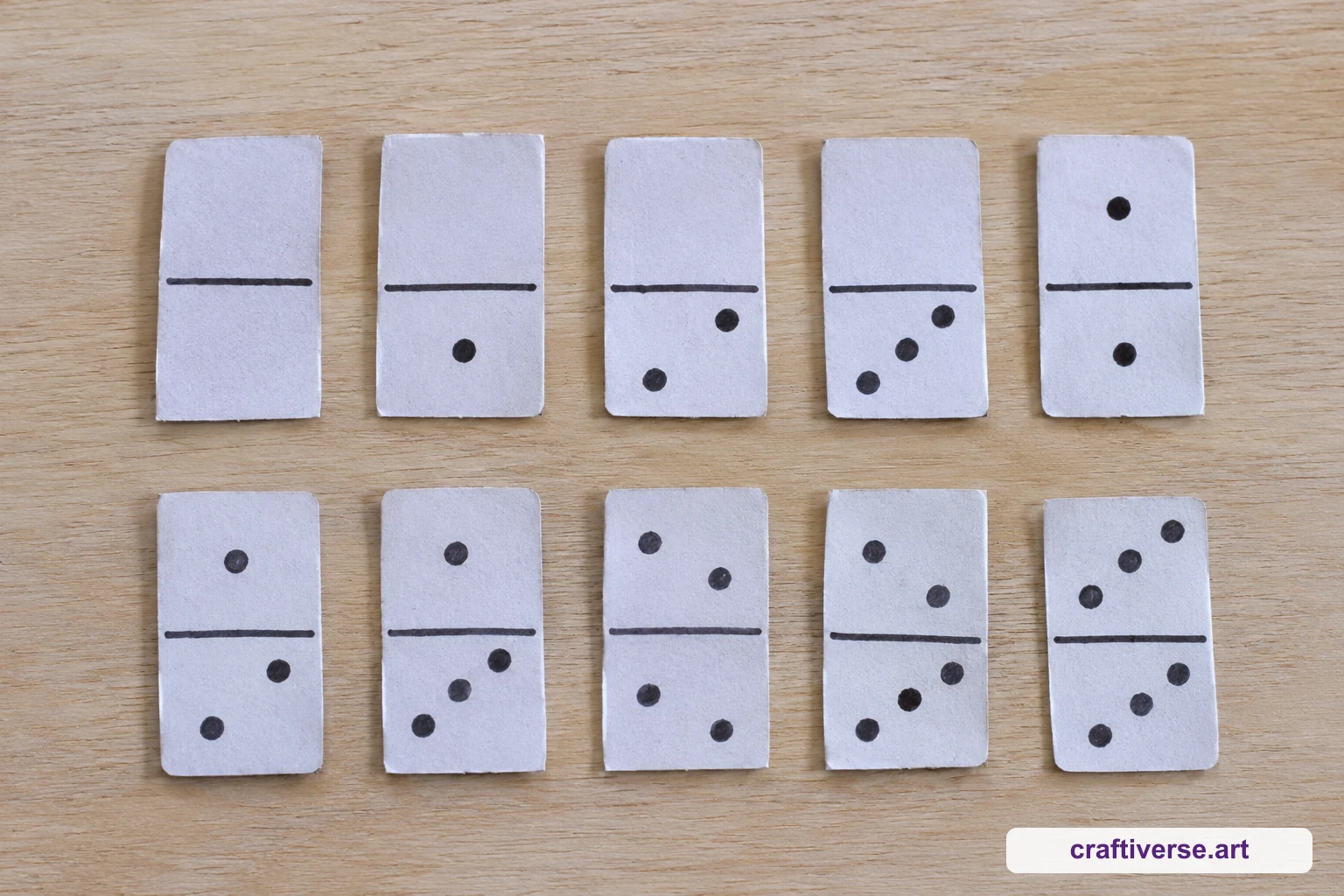
Use a complete ten-tile set with values from zero to three. Zero is a blank half.
Materials
- Ten same-sized rectangles of thin card
- Marker
- Scissors or prepared rectangles
How to make it
- Prepare ten rectangular tiles and draw a line across the middle of each.
- Make exactly these tiles: 0–0, 0–1, 0–2, 0–3, 1–1, 1–2, 1–3, 2–2, 2–3 and 3–3.
- Use dots or clear numbers for the values. Leave zero halves blank if you choose dots.
- Check the set against the list: every unordered pair appears once, with no missing or duplicate tiles.
- Leave the backs plain, turn the tiles face down and mix them.
How to play
- For two players, each takes three tiles. Leave the remaining four face down as the draw pile.
- The first player places any tile in the middle. On later turns, place one tile at either open end of the chain, matching the touching values. Rotate tiles if needed.
- If you cannot play, draw one tile. Play it immediately if it fits; otherwise keep it and pass. When the draw pile is empty, pass if you cannot play.
- A player who uses all their tiles wins. If the draw pile is empty and both players pass consecutively, add the dots or numbers on each remaining hand: the lower total wins. Equal totals are a shared win.
3. Paper tic-tac-toe
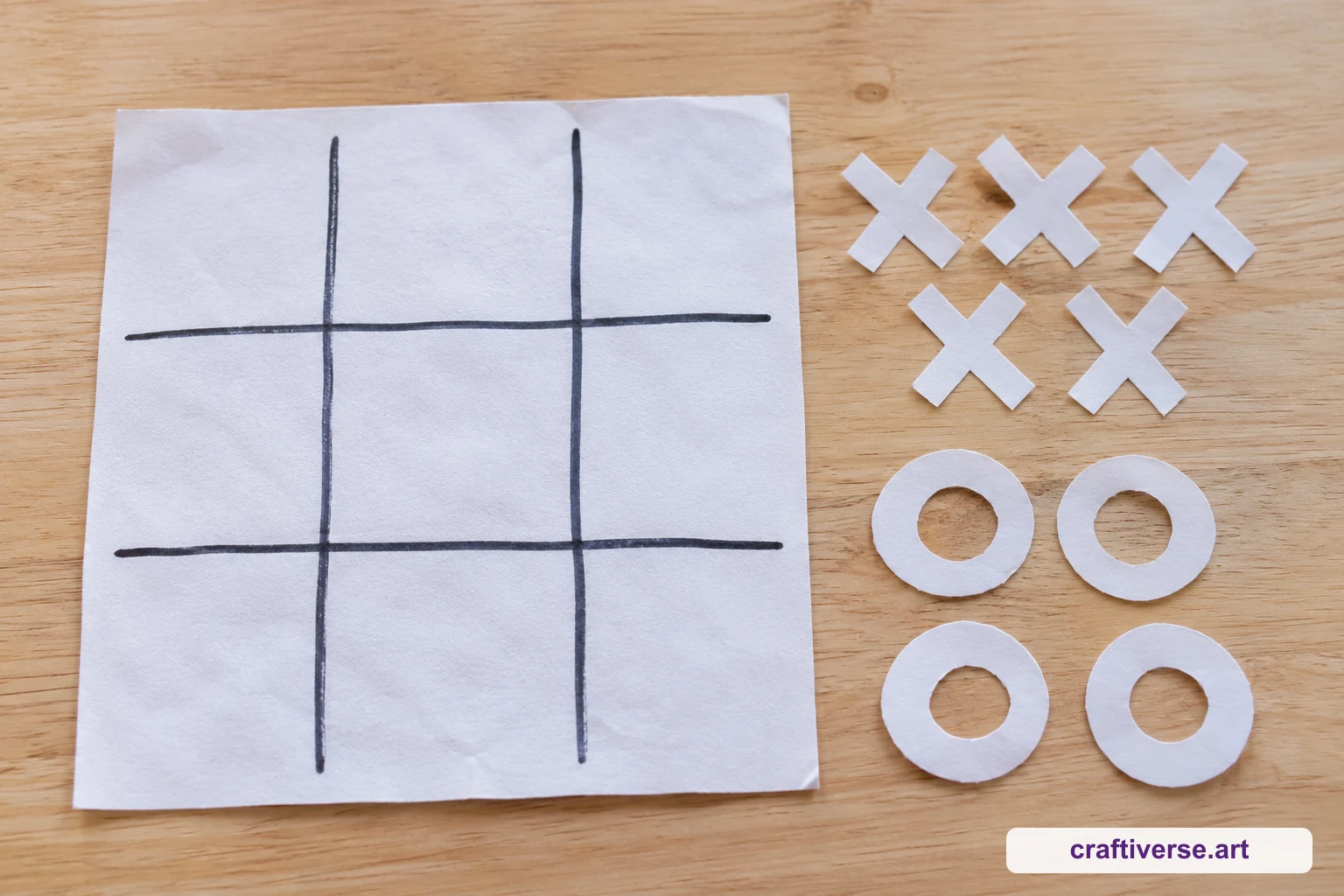
Use an exact three-by-three board, with X going first.
Materials
- One sheet of paper
- Marker or pencil
- Optional separate large paper X and O pieces
How to make it
- Draw two vertical lines and two horizontal lines to make nine cells in a three-by-three grid.
- Decide whether to draw a mark each turn or use reusable paper pieces.
- For reusable pieces, prepare five X pieces and four O pieces, large enough to pick up easily.
- Agree who uses X and who uses O. Keep a spare sheet for another round if you are drawing directly on the board.
How to play
- X places the first mark in any empty cell. O takes the next turn.
- Keep alternating, placing one mark per turn in an empty cell only.
- The first player to have three of their marks in one horizontal, vertical or diagonal line wins.
- If all nine cells fill without a winning line, the round is a draw. Clear the board or use a new grid to play again.
4. Ten-space paper race
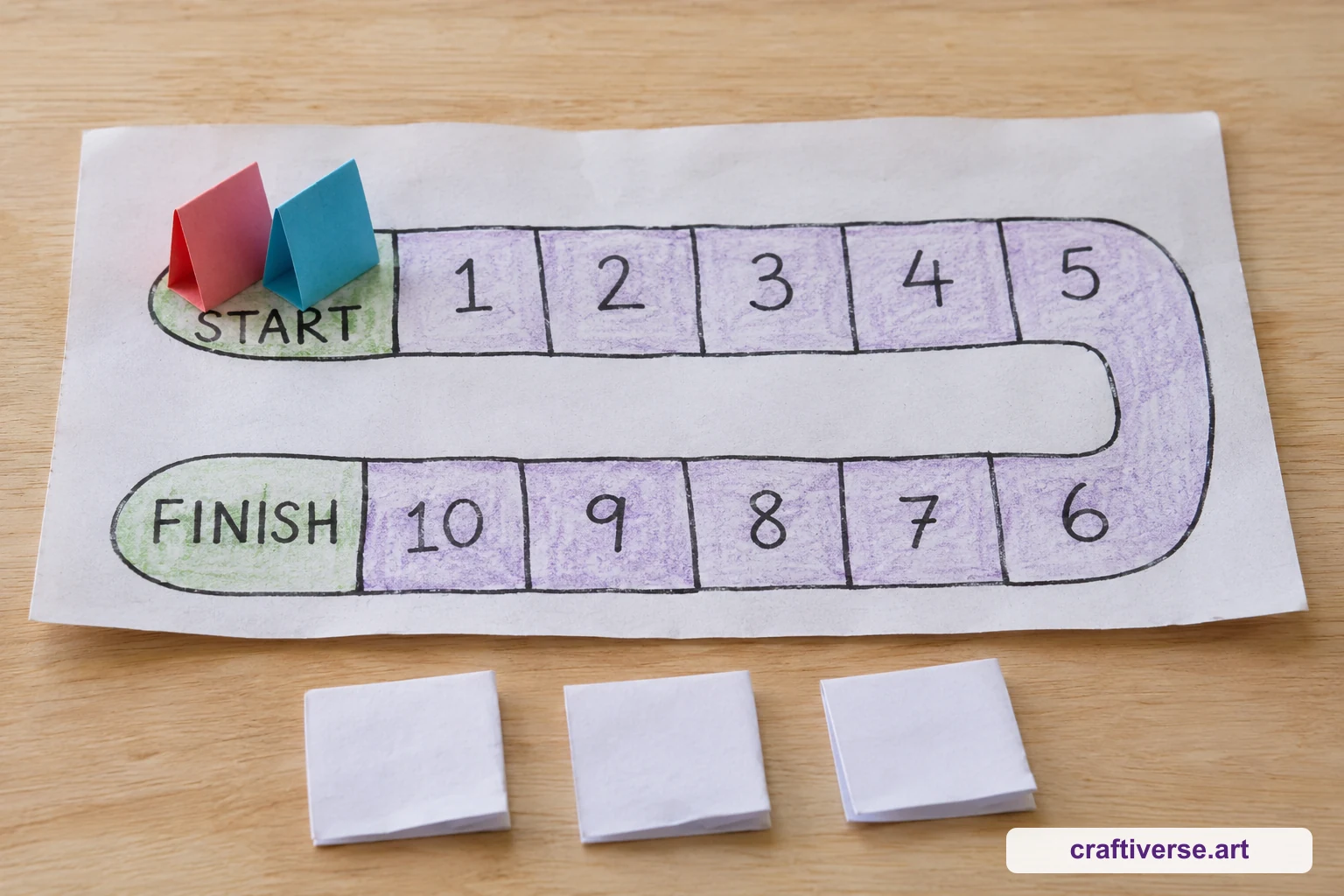
Use three draw tickets instead of a die. This is a short, chance-based game for two players.
Materials
- One race-board sheet
- Two folded-paper markers in different colors
- Three same-sized paper tickets
- Pencil or marker
How to make it
- Draw ten connected spaces and label them 1 to 10. Mark the place before space 1 as START and space 10 as FINISH.
- Arrange the route clearly. On the free sheet, the top row runs 1 to 5 and the bottom row continues right to left from 6 to 10.
- Fold two different colored paper scraps into small upright markers, or use two larger flat pieces.
- Write 1, 2 and 3 on three identical tickets. Fold them the same way so the values are hidden.
- Place the tickets in a pile and mix them. Put both player markers at START before the first space.
How to play
- Choose the first player. On a turn, draw one ticket and reveal its number.
- Move that many spaces forward, following the numbers in order. Both markers may share a space.
- Return the ticket to the pile, fold it, and mix all three tickets before the other player’s turn.
- The first player to reach or pass space 10 wins. An exact finish number is not required.
5. Draw-and-guess prompt cards
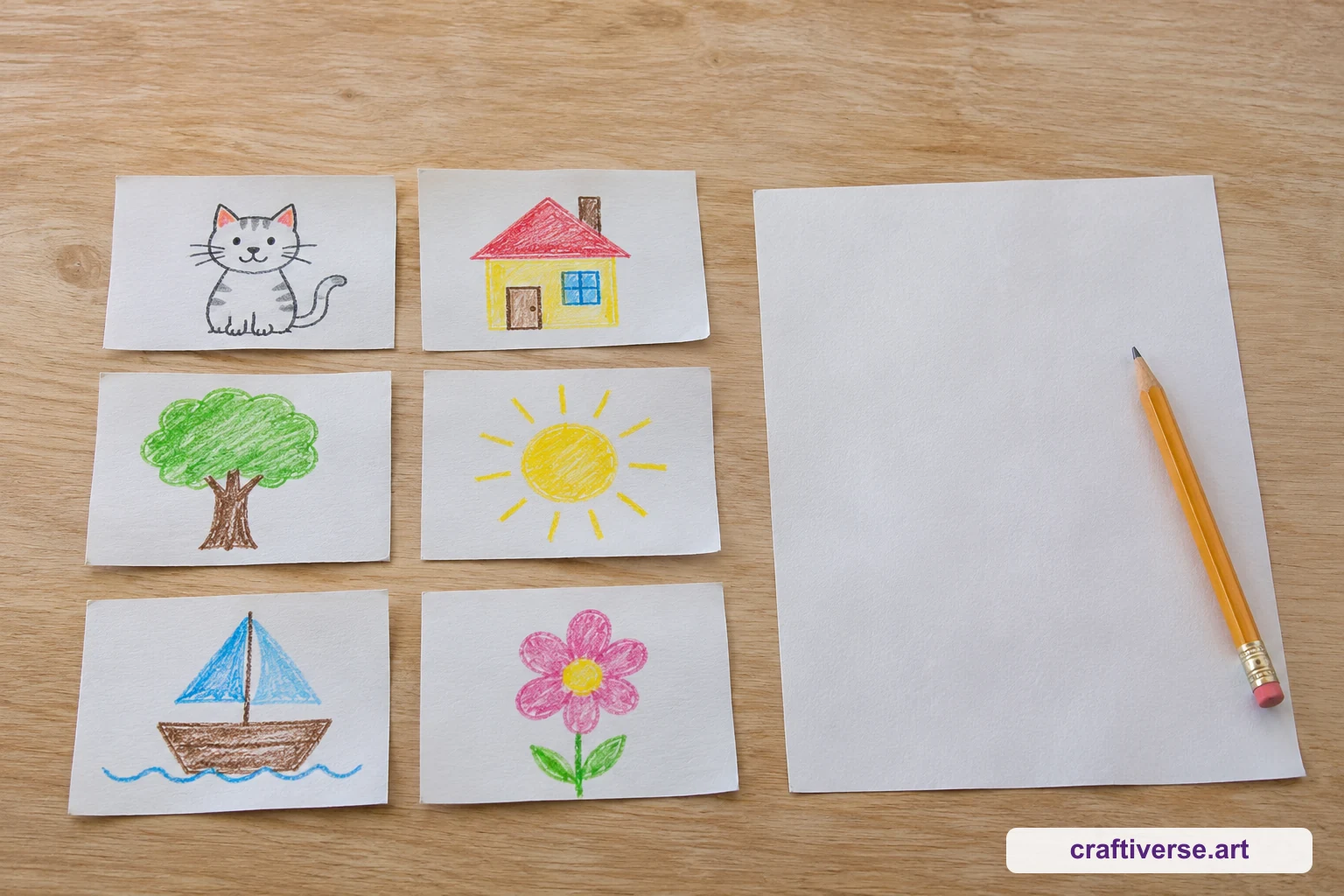
Make a small set of familiar prompts and use drawing as a shared guessing activity.
Materials
- Paper for prompt cards
- Spare drawing paper
- Pencil, crayons or markers
- Optional prepared card rectangles
How to make it
- Prepare six or more prompt cards. Draw or write one familiar thing on each, such as a cat, house, tree, sun, boat or flower.
- Choose things everyone knows. A grown-up can label pictures or read a prompt quietly if needed.
- Place the cards face down and set out a separate drawing sheet.
- Agree that there is no time limit and that passing on an unfamiliar prompt is allowed.
How to play
- The drawer takes a prompt without showing the other player.
- Draw clues on the spare paper while the other player guesses. Avoid writing the answer itself.
- After a correct guess, or whenever the drawer wants to reveal it, show the card and swap roles.
- Play until each person has had the same number of turns. Keep no score, or award the pair one shared point for each solved prompt.
Choose a game for the group you have
Matching pairs and tic-tac-toe work well as short two-person starts. The race uses chance, while dominoes asks players to notice matching ends. Draw-and-guess can be played cooperatively without a winner. Choose the kind of interaction you want before choosing the prettiest board.
Read a rule aloud and demonstrate it with the pieces. If a player needs repeated help, keep the pieces face up, reduce the set or play as a team. Making the game easier is a useful design choice, not a failed attempt.
Store the pieces so the game can be played again
Keep each set in a separate paper envelope or folder. Write the number of pieces on the front: twelve matching cards, ten dominoes, nine tic-tac-toe pieces, or two race markers and three tickets. Count them back in after play.
Save a simple rules note with the set. If you change a rule, agree it before the next round and write it down so everyone is playing the same version.
Common questions
Do we need a printer?
No. Draw the grids and pieces by hand, or use the free play sheets. A grown-up can prepare the cut pieces.
Can these games be played alone?
Matching pairs can be a solo search, and a child can design a board or practice fitting dominoes. The competitive rules provided are for two players.
What happens if the domino game gets stuck?
When the draw pile is empty and both players pass consecutively, compare the totals left in their hands. Lower total wins; equal totals are a shared win.
Does the race need an exact number to finish?
No. Reaching or passing space 10 wins. Return the movement ticket and mix all three tickets after every turn.
Explore more activities in the Craftiverse library
Keep making
Save this craft for later
Save on Pinterest · Download the Pin image
